Designing a High-Speed Overwrapping and Case Packing Line for Rigid Products
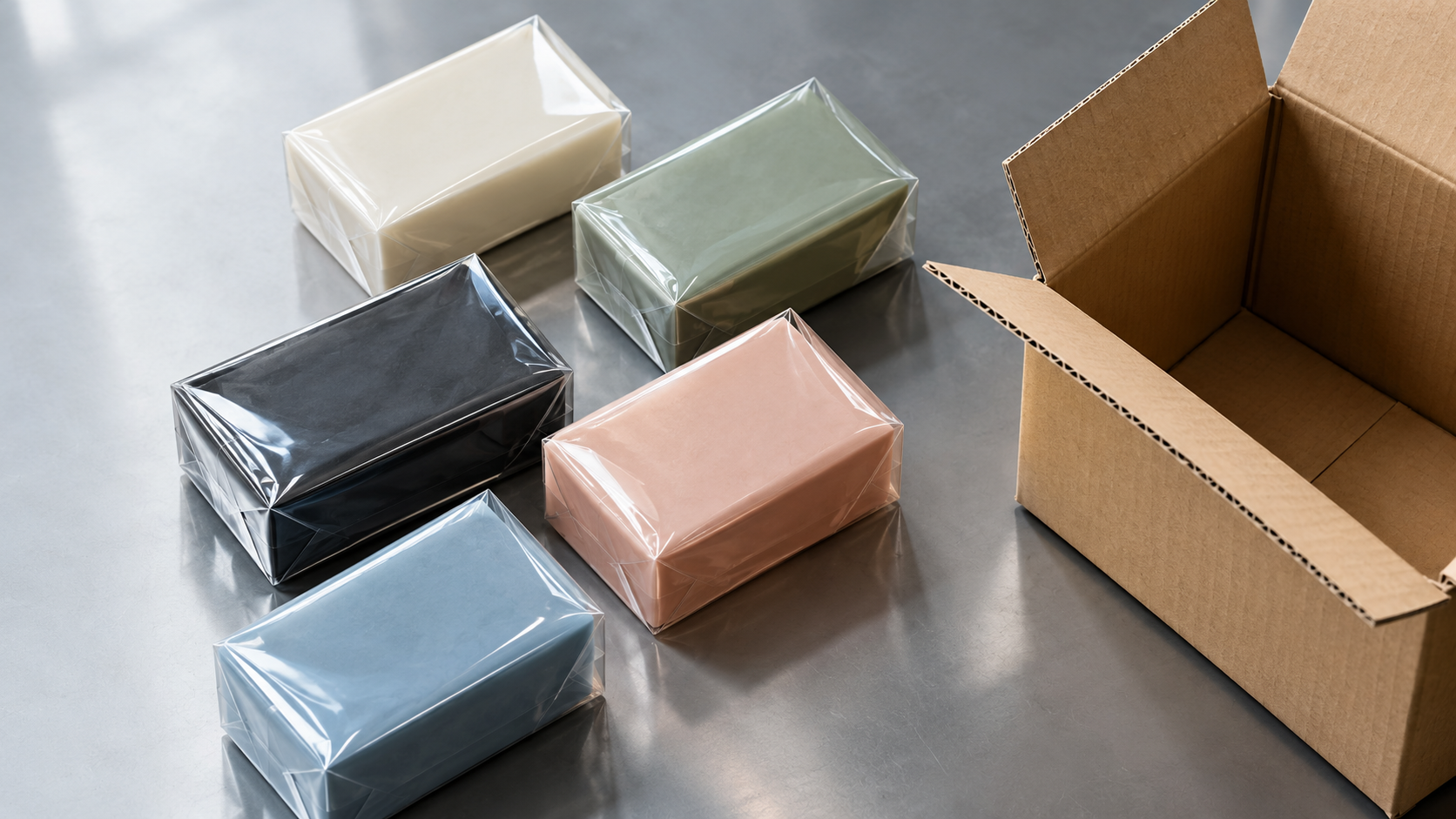
Why rigid block products need a different end-of-line layout
Rigid blocks hold their own shape, so they can be grouped, folded and stacked without a tray or a shrink tunnel. That is the property the whole line is built around: a fixed bundle geometry can be wrapped, weighed and placed into a carton by pick-and-place rather than dropped. The trade-off is that every format change touches three stages at once — the fold tooling, the weigh tolerance band and the carton size — so the line is designed around a small family of bundle sizes rather than a single fixed one.
How 3D transparent film overwrapping works
3D overwrapping folds film around the grouped product the way a gift is wrapped: the film is drawn over the block, the corners are folded flat and the overlapping flaps are heat-sealed. The result is a closed pack with fold corners and no loose film tails, which reads as a premium finish and keeps the product surface protected in the carton.
- Products are grouped first, for example into 2x2x1 blocks, so the wrapper handles one bundle instead of individual pieces.
- Feeding, stacking and folding are servo-driven; the heat-sealing side flaps are PLC-controlled so the seal closes without marking the product underneath.
- BOPP or PVC film is used, typically 20–30 microns thick.
- Output depends on film thickness and bundle size, running at 10 to 35 bundles per minute.
How dynamic checkweighing works on the line
A dynamic checkweigher sits between the wrapper and the case packer and weighs each bundle in motion. A high-precision load cell, such as a Mettler Toledo unit, is paired with an FPGA hardware filter so the reading separates product mass from conveyor vibration. The controller compares the measured weight with the target band; a bundle that is short a piece, or wrapped with an empty film roll, falls outside the band and a pneumatic pusher removes it before it can reach the carton.
Placing the checkweigher after wrapping rather than after case packing means a reject costs one bundle, not a full carton, and the case packer only ever receives bundles that have already passed.
Integrating overwrapping and case packing
The packing end is where line design usually decides between separate machines and an integrated unit. A compact integrated case erector and packer such as the ZC-IT600 erects, loads and seals on a single frame with a balcony-style layout, so the working parts are reachable for inspection and maintenance. A dual-servo robotic arm on imported linear guide rails picks the overwrapped bundles and places them into the carton layer by layer, using vacuum suction and positioning sensors.
- Carton sizes: handwheel adjustments cover format changes.
- Inserts: instruction manuals, cardboard dividers or certificates of conformity can be placed alongside the product.
- Capacity: box forming runs at up to 8 cases per minute, which keeps pace with the upstream wrapper.
The same packing duty can be handled by a high speed case packing machine when the carton range and packing pattern call for a different frame.
Buffer, metering and line control
A batch-packing case erector cannot take an uninterrupted stream of loose bundles, so the infeed conveyor needs accumulation and photoelectric sensors to meter the flow. Above that, the three stages share one control architecture: Siemens PLCs and servo motors with Schneider electrical components let the wrapper, checkweigher and case packer exchange status. If the case packer jams, the upstream machines pause instead of piling bundles onto the floor.
Where the design limits sit
| Stage | Equipment | Design point |
|---|---|---|
| Primary wrapping | 3D transparent film overwrapper | 10–35 bundles/min; BOPP or PVC film; fold-corner sealing |
| Quality control | Dynamic checkweigher | Up to 30 pcs/min; ±10 g accuracy; air-pusher rejection |
| Secondary packing | Integrated case erector and packer | Up to 8 cases/min; dual-servo robotic arm; carton shortage detection |
| Line control | Siemens PLC and HMI | Servo synchronization; fault alarms; recipe management |
The wrapper is normally the constraint: bundle size and film thickness set its rate, and the checkweigher and case packer are sized to stay ahead of it. When a new bundle format is planned, the fold tooling, weigh band and carton dimensions are defined per project with our engineers rather than assumed from the previous format.